


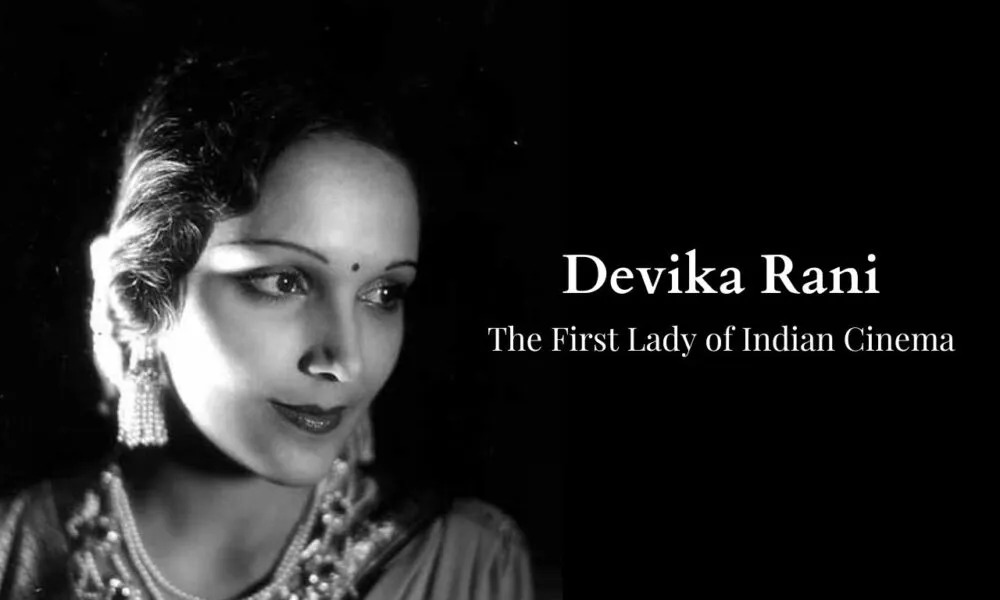
A New Headline for a Legendary Story
“Devika Rani: From Scandal to Stardom, How the First Lady of Indian Cinema Forged Bollywood’s Corporate Backbone”A Star Born in London, Forged in Berlin
In the annals of cinema, few stories carry the glamour and grit of Devika Rani’s. Born in 1908 into an elite Bengali family, she was dispatched to England at nine, where she absorbed the discipline of boarding school and immersed herself in the arts. At RADA she studied acting, but her curiosity stretched further—architecture, textile design, and even an apprenticeship under Elizabeth Arden. This cosmopolitan training gave her a rare sophistication that she later injected into Indian cinema. Her fateful meeting with Himanshu Rai in 1928 changed everything. Rai, a filmmaker with global ambitions, hired her as art director and costume designer for A Throw of Dice. Their marriage and subsequent training at Berlin’s UFA Studios armed them with cinematic precision that India had never seen before.
A Kiss That Shocked the World
Her entry into acting was nothing short of sensational. In 1933, she starred in Karma, a bilingual film that shocked audiences worldwide with a four‑minute on‑screen kiss with her husband. At a time when Indian cinema was still tentative about depicting intimacy, Devika’s boldness made headlines across continents. She was not just a pretty face; she embodied modernity, independence, and unapologetic femininity. Her roles often centered on women who were strong, intelligent, and central to the narrative, breaking away from the submissive archetypes that dominated early Indian films. This global debut positioned her as a star of international stature, and she became a symbol of how Indian cinema could compete with Western standards. The kiss in Karma was more than scandalous—it was revolutionary, signaling that Indian films could be daring, sophisticated, and emotionally complex.
Bombay Talkies: Bollywood’s First Empire
The founding of Bombay Talkies in 1934 marked the true beginning of Devika Rani’s empire. Alongside Himanshu Rai, she created India’s first corporate studio, modeled on the efficiency of German film companies. Bombay Talkies introduced strict work culture: punch‑card attendance systems, khaki uniforms for technicians to eliminate hierarchy, and mandatory training sessions conducted by German experts like Franz Osten and Josef Wirsching. This was revolutionary in an industry that had previously been disorganized and informal. Under Devika’s leadership, Bombay Talkies produced films that were not only technically superior but also socially conscious. Achhoot Kanya (1936), starring Devika and Ashok Kumar, tackled caste discrimination head‑on, proving that cinema could be both entertaining and socially transformative. When Himanshu Rai died in 1940, many expected Devika to retreat, but instead she took full control of the studio, defying the male‑dominated industry. She managed productions, balanced finances, and continued to push for films that blended artistry with social relevance.
Scandal, Rivalry, and the Birth of Stars
Her talent for spotting stars was legendary, and nowhere was this clearer than in her discovery of Dilip Kumar. In 1943, she encountered Yusuf Khan, a young man working at a British army canteen. Struck by his charisma and eloquence, she hired him at Bombay Talkies, initially as a scriptwriter. Recognizing his potential, she launched him as a leading actor in Jwar Bhata (1944), and it was Devika who suggested he adopt a screen name. From her list of options, Yusuf chose “Dilip Kumar,” a name that would become synonymous with tragedy and romance in Indian cinema. Though his debut faltered, Devika shielded him from criticism and nurtured his growth, grooming him into the “Tragedy King.” Her mentorship was pivotal in shaping Dilip Kumar’s career, and it demonstrated her uncanny ability to see beyond raw talent to the potential for stardom. This gift of discovery extended beyond Dilip Kumar; she had earlier elevated Ashok Kumar to hero status after the scandalous exit of Najm‑ul‑Hassan. In both cases, her instincts rewrote the destiny of Indian cinema, proving that her influence was not limited to her own performances but extended to shaping the careers of icons who would dominate the industry for decades.
The Civil War of Bombay Talkies
Yet Devika Rani’s career was not without turbulence. The 1936 elopement scandal with Najm‑ul‑Hassan nearly destroyed Bombay Talkies. Himanshu Rai’s fury led to Hassan’s permanent blacklisting, and the studio was left scrambling for a replacement hero. Rai’s desperate choice of Kumudlal Ganguly, rechristened Ashok Kumar, turned out to be a masterstroke. Ashok Kumar’s rise was accidental, but it reshaped Bollywood’s star system. Later, after Rai’s death, Devika faced an even greater challenge: the internal civil war with Sashadhar Mukherjee. The studio split into rival camps, with Devika leading one side and Mukherjee, backed by Ashok Kumar and Gyan Mukherjee, leading the other. The rivalry produced sabotage, rumors, and box‑office battles. Mukherjee’s camp triumphed with hits like Bandhan and Jhula, while Devika’s productions faltered. The breaking point came with Kismet (1943), which ran for three and a half years in Calcutta and generated unprecedented profits. Flush with success, Mukherjee and his allies walked out to form Filmistan Studios, poaching Bombay Talkies’ top talent. Devika, left with a hollowed‑out studio, fought valiantly by launching Dilip Kumar, but the exhaustion of constant battles eventually drove her to sell her shares and retire in 1945.
Retirement and Legacy
Her retirement was as dramatic as her career. At the peak of her power, she shocked the industry by walking away, marrying Russian painter Svetoslav Roerich, and retreating to a 460‑acre estate in Bangalore. There she lived a reclusive life, focusing on art and leaving cinema behind. Yet her legacy endured. She was awarded the Padma Shri in 1958 and became the first recipient of the Dadasaheb Phalke Award in 1969, cementing her place as the “First Lady of Indian Cinema.” Devika Rani’s impact cannot be overstated: she professionalized Indian filmmaking, discovered its greatest stars, and proved that women could lead in an industry dominated by men. Her story is one of brilliance, scandal, resilience, and vision. She transformed Indian cinema from a chaotic pastime into a disciplined industry, and her fingerprints remain on its foundation.
The Suspense of What Could Have Been
Hollywood loves a “what if,” and Devika Rani’s saga leaves us with tantalizing possibilities. What if she had not retired in 1945? Could Bombay Talkies have rivaled Filmistan and RK Studios? Would Dilip Kumar’s rise have been accelerated, reshaping the balance of stardom against Ashok Kumar? Might another scandal have erupted, where Devika’s uncompromising professionalism collided with the emerging star system of post‑Independence India? These speculative arcs create suspense for readers, ensuring that her legend continues to inspire and intrigue.
Closing Frame
Devika Rani’s story is not just about cinema; it is about discipline, scandal, discovery, and survival. She professionalized Indian filmmaking, launched legends, and fought bitter corporate wars. Her departure left a vacuum, but her fingerprints remain on every corner of Bollywood’s foundation. For Hollywood readers, her saga resonates as a tale of ambition, resilience, and reinvention — the kind of story that could itself be a film, complete with glamour, betrayal, and triumph.