


Prologue: A Station Encounter
Bombay, 1943. The city was alive with wartime uncertainty, yet its train stations bustled with energy, commerce, and chance encounters. Among the crowd stood a young man from Peshawar — Muhammad Yusuf Khan. He was 20, unemployed, and searching for opportunity after running a canteen in Pune. Fate intervened when he met Dr. Masani, a former professor, who introduced him to the world of cinema through Bombay Talkies.
That single meeting would alter the course of Indian film history.
The Discovery
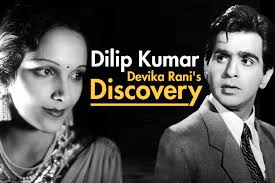
Bombay Talkies was then one of the most influential studios in India. Its head, Devika Rani, was a formidable actress and producer, known for her sharp eye for talent. When Yusuf Khan walked into her office, she was struck not only by his striking looks but also by his command of Urdu — a language that carried poetry, refinement, and gravitas.
She saw in him the makings of a star. Handsome, articulate, and dignified, Yusuf Khan embodied the qualities that could captivate audiences. Devika Rani offered him a contract with a monthly salary of Rs 1,250 — a princely sum for a young man with no film background.
The Name Change
But there was a complication. Yusuf Khan came from a conservative family that might object to his entry into films. Devika Rani, ever pragmatic, suggested a solution: a new identity. She gave him the name Dilip Kumar — a name that would soon become synonymous with Indian cinema’s golden age.
The rechristening was more than cosmetic. It was a transformation, a rebirth. Yusuf Khan became Dilip Kumar, stepping into a world of lights, cameras, and scripts, leaving behind the anonymity of his past.
The First Film: Jwar Bhata (1944)
Dilip Kumar’s debut came in Jwar Bhata, directed by Amiya Chakravarty. The film was a drama, and though it did not catapult him to instant stardom, it marked the beginning of a career that would span five decades.
Behind the scenes, Dilip Kumar was raw, unpolished, and nervous. His first shot required him to run to rescue the heroine. Being athletic, he sprinted so fast that the cameras couldn’t keep up. Chakravarty had to stop the scene and instruct him to “run like a common man, not a racer.” It was a moment of humility, a reminder that acting was not about physical prowess but about controlled expression.
Interestingly, a young Raj Kapoor, his childhood neighbor from Peshawar, was working as an assistant director on the film. Kapoor guided him through the nuances of filmmaking, offering support during those uncertain first steps.
Reception and Aftermath
Jwar Bhata released in November 1944 at Majestic Cinema in Bombay. The film received a lukewarm response. Critics were not impressed, and audiences did not immediately embrace the newcomer. But Dilip Kumar was undeterred. He had tasted cinema, and he was determined to refine his craft.
This resilience would define his career. Unlike many actors who faded after a weak debut, Dilip Kumar studied the art of acting meticulously. He observed, learned, and transformed himself into what critics would later call the “Tragedy King” — a master of emotional depth and subtlety.
The Larger Context
The 1940s were a transformative decade for Indian cinema. Studios like Bombay Talkies were experimenting with themes of nationalism, social reform, and romance. Actors were not just entertainers; they were cultural icons shaping public imagination. Dilip Kumar entered this world at the right time, with the right mentors, and with a name that carried gravitas.
His journey from Yusuf Khan to Dilip Kumar was symbolic of cinema’s power to reinvent identities. It was also a reflection of India’s own transformation — a nation on the cusp of independence, redefining itself through art and culture.
Legacy of the Launch
Though Jwar Bhata did not make him a star, it laid the foundation for a career that would later include classics like Andaz (1949), Devdas (1955), Mughal-e-Azam (1960), and Ganga Jamuna (1961). Each role built upon the lessons of his debut — the importance of restraint, the art of emotional expression, and the ability to embody both vulnerability and strength.
The story of his launch is not just about a film. It is about chance encounters, mentorship, reinvention, and persistence. It is about a young man who embraced a new identity and, in doing so, became one of the greatest actors in Indian cinema.
Epilogue: From Yusuf to Dilip
The railway station meeting in 1943 was the spark. Devika Rani’s vision was the catalyst. Jwar Bhata was the first step. Together, they created Dilip Kumar — a name that would echo across generations.
Behind the glamour lies a simple truth: legends are not born overnight. They are shaped by chance, guided by mentors, and forged in the crucible of failure and persistence. Dilip Kumar’s launch story is proof that destiny often begins with a single encounter — and a new name.