


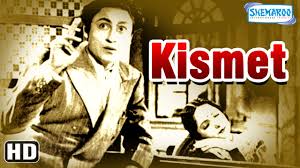
Ashok Kumar’s 1943 Blockbuster That Rewrote Box Office History
A Nation at the Crossroads
In 1943, India was still under British colonial rule, the Second World War was raging, and cinema was emerging as a powerful cultural force. Amidst this backdrop, Bombay Talkies released Kismet, directed by Gyan Mukherjee and starring Ashok Kumar. The film arrived at a time when audiences were hungry for stories that reflected both their anxieties and aspirations. The war had created shortages, censorship was strict, and yet cinema halls were packed with people seeking escape.
Kismet tapped into this collective mood by offering a narrative that was both entertaining and daring. It was not just another melodrama; it was a film that challenged conventions. Ashok Kumar’s portrayal of Shekhar, a pickpocket and conman, was unlike anything audiences had seen before. He was charming, flawed, and morally ambiguous—a stark departure from the upright heroes of the era. This anti‑hero archetype resonated with viewers who themselves were navigating a world of uncertainty.
The film’s release was also significant because it coincided with India’s independence movement. Songs written by Kavi Pradeep carried subtle patriotic undertones, giving audiences a sense of solidarity. In many ways, Kismet became more than a film; it was a cultural event that reflected the zeitgeist of 1940s India.
The Accidental Superstar
Ashok Kumar’s journey to superstardom was entirely accidental. Born Kumudlal Kunjilal Ganguly in Bhagalpur, Bihar, he had no ambitions of becoming an actor. He worked as a lab assistant at Bombay Talkies, handling film processing and technical work. Fate intervened when the studio needed a replacement actor, and Kumar was thrust into the spotlight.
By the time Kismet released, Kumar had already appeared in several films, but this project transformed him into India’s first superstar. His naturalistic acting style—subtle gestures, conversational dialogue, and understated emotions—was revolutionary. Unlike the theatrical performances common in the 1930s and 1940s, Kumar’s approach felt authentic. Audiences connected with him because he seemed real, not larger‑than‑life.
His portrayal of Shekhar in Kismet was groundbreaking. Playing a thief who nevertheless won audience sympathy, Kumar challenged the notion that heroes had to be morally perfect. This role paved the way for later anti‑heroes in Indian cinema, from Amitabh Bachchan’s “angry young man” to Shah Rukh Khan’s darker roles in Baazigar and Darr.
Kumar’s accidental rise to superstardom also influenced his peers. He became a mentor to Dilip Kumar, guiding him in the art of naturalistic acting. Their lifelong friendship and professional camaraderie shaped the golden era of Hindi cinema.
Bold Themes and Cultural Impact
Kismet was daring for its time. It tackled subjects that were considered taboo in 1940s India. The film depicted an unmarried woman’s pregnancy, a storyline that shocked audiences but also reflected social realities. By addressing such themes, Kismet expanded the boundaries of what cinema could portray.
The film also carried nationalist undertones. Patriotic songs composed by Anil Biswas and written by Kavi Pradeep resonated with audiences yearning for independence. These songs were subtle enough to pass censorship but powerful enough to evoke solidarity. In a time when open political expression was risky, cinema became a medium through which collective aspirations could be voiced.
The anti‑hero archetype introduced in Kismet was another bold innovation. Ashok Kumar’s Shekhar was not a conventional hero. He was flawed, morally ambiguous, and yet deeply human. This portrayal challenged audiences to rethink their notions of heroism. It also paved the way for more complex characters in Indian cinema.
Culturally, Kismet became a phenomenon. It was discussed in newspapers, debated in social circles, and remembered for decades. Its success proved that cinema could be both commercially massive and socially daring.
Box Office Records and Legacy
Kismet was produced on a modest budget of around ₹2 lakh. It went on to gross ₹1.6 crore, making it the first Indian film to cross the ₹1 crore mark. This was a staggering figure for its time, especially considering the economic challenges of wartime India.
The film ran for 184 weeks—over three and a half years—at Kolkata’s Roxy Cinema. This record stood unchallenged for 32 years until Sholay broke it in 1975. Estimates suggest that Kismet was watched by over 3.5 crore viewers, surpassing even modern hits in terms of footfalls.
Its box office success transformed Ashok Kumar into India’s first superstar. He was no longer just an actor; he was a phenomenon. The film’s unprecedented success also proved that cinema could be a mass medium capable of shaping culture and society.
The legacy of Kismet extended beyond its box office records. It inspired remakes in Tamil (Prema Pasam, 1956), Telugu (Bhale Ramudu, 1956), and later in Hindi (Boy Friend, 1961). Its influence can be seen in later blockbusters that combined daring themes with mass appeal.
Closing Note – Cinema’s Turning Point
Kismet was more than a film; it was a turning point in Hindi cinema. Released during colonial India, it gave audiences entertainment, social commentary, and patriotic resonance. Its unprecedented success changed the trajectory of Indian cinema, proving that films could be both commercially massive and socially daring.
Ashok Kumar’s accidental rise to superstardom through Kismet remains one of the most defining stories in Bollywood history. His naturalistic acting style, the film’s bold themes, and its box office success collectively revolutionized the industry.
For 32 years, Kismet’s record remained unbroken, a testament to its enduring power. Even today, it is remembered not just as a film but as a cultural phenomenon that changed the destiny of Hindi cinema.