


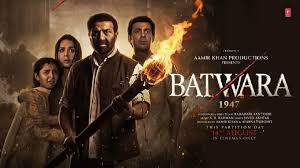
Character Posters Signal Santoshi’s Return to Historical Storytelling
Introduction: Partition as Cinematic Memory
Few historical ruptures carry as much generational weight as the Partition of 1947. Hindi cinema has revisited this trauma through films like Garam Hawa (1974), Tamas (1987), and Pinjar (2003), each offering a lens into displacement, identity, and survival. Now, Rajkumar Santoshi’s Batwara 1947 positions itself within this lineage, promising a sweeping ensemble drama backed by Aamir Khan Productions.
The unveiling of character posters has intensified anticipation. Sunny Deol and Shabana Azmi lead a cast that includes Preity Zinta, Karan Deol, Ali Fazal, and Abhimanyu Singh. Each poster leans into grief, endurance, and defiance, signalling that Santoshi’s narrative will foreground human resilience rather than spectacle alone.
Santoshi’s Return and Reunion with Deol
Rajkumar Santoshi’s oeuvre has long been associated with emotionally charged cinema—Ghayal, Damini, Ghatak. His reunion with Sunny Deol after nearly three decades carries both nostalgia and dramatic promise. Deol’s screen persona, rooted in conviction and intensity, dovetails naturally with Santoshi’s penchant for moral confrontation.
This collaboration situates Batwara 1947 as more than a historical drama; it is a creative reunion that evokes memories of Hindi cinema’s most forceful narratives.
Character Posters: Visual Language of Survival
The newly unveiled posters eschew flamboyance. Instead, they foreground expressions, posture, and presence. Azmi’s dignified gravitas, Deol’s resolute gaze, Zinta’s quiet endurance, Fazal’s intensity, and Singh’s brooding menace collectively communicate the film’s emotional register.
The caption accompanying the reveal—“In a world torn apart, their story was a testament to courage”—underscores the campaign’s intent. The posters are not mere marketing artefacts; they are proclamations of human resilience amidst historical catastrophe.
The Film’s Framework
Batwara 1947 is scheduled for worldwide release on 14 August 2026, deliberately aligned with Partition remembrance. This choice imbues the film with historical gravitas, ensuring its resonance extends beyond cinematic spectacle.
The creative team adds further anticipation:
- Director: Rajkumar Santoshi (National Award‑winning filmmaker)
- Producer: Aamir Khan Productions
- Music: A. R. Rahman
- Lyrics: Javed Akhtar
For a story anchored in displacement and survival, Rahman and Akhtar’s collaboration promises a soundtrack of emotional and historical depth.
Partition Cinema: A Historical Lineage
To understand Batwara 1947’s significance, one must situate it within Partition cinema’s lineage:
- Garam Hawa (1974): M. S. Sathyu’s masterpiece centred on a Muslim family grappling with displacement.
- Tamas (1987): Govind Nihalani’s television epic adapted from Bhisham Sahni’s novel, exploring communal violence.
- Pinjar (2003): Chandraprakash Dwivedi’s adaptation of Amrita Pritam’s novel, foregrounding female trauma.
Each of these works emphasised human cost over political abstraction. Santoshi’s posters suggest a similar trajectory—foregrounding faces, emotions, and survival.
Sunny Deol’s Current Trajectory
Deol’s recent phase has kept him tethered to conviction‑driven storytelling. His screen presence continues to resonate with audiences drawn to intensity and moral clarity. Batwara 1947 arrives at a moment when his stature as a performer dovetails naturally with Santoshi’s narrative ambitions.
Upcoming projects like Subedaar (2026) and King (in production) further cement his dual identity as both nostalgic icon and contemporary stalwart.
Conclusion: A Campaign Rooted in Memory