


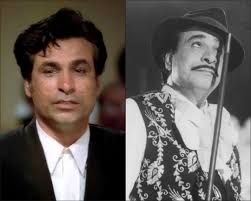
Prologue: A Star Born in Shadows
Few journeys in Bollywood are as inspiring as that of Kader Khan. His life began in Kabul, Afghanistan, where tragedy struck his family repeatedly. Three of his elder brothers died before the age of eight, leaving his parents devastated. Believing their homeland cursed, the family migrated to Bombay in the early 1940s. They settled in Kamathipura, one of the city’s most notorious slums, infamous for crime, drugs, and gangsters. Poverty was crushing, and survival was a daily battle. Yet, amidst this bleak environment, a boy named Kader Khan began to dream. He would rise from these shadows to become one of the most prolific figures in Indian cinema, acting in over 300 films and writing dialogues for more than 250. His journey was a testament to grit, resilience, and the unwavering love of his mother.
Act I: Childhood and the Mother’s Promise
In Kamathipura, Kader Khan’s childhood was marked by hunger and hardship. His parents separated, leaving his mother, Iqbal Begum, to raise him alone. Often, the family went to bed hungry. Like many slum children, Kader considered quitting school to work at a local mill for three rupees a day. But his mother stopped him. She told him, “If you become a daily labourer today, your Rs 3 per day will remain the same forever. If you want to get rid of this poverty, you must educate yourself first.” Those words became his guiding light. He promised his mother he would study, and he did so under extreme circumstances, eventually graduating. Her wisdom and sacrifice shaped his destiny, and throughout his life, he credited her for saving him from a life of obscurity.
Act II: Education and the Professor Years
Kader Khan excelled academically. He attended a municipal school and later Ismail Yusuf College, where he earned a degree in Civil Engineering. His brilliance led him to a teaching career. Between 1970 and 1975, he taught as a Professor of Civil Engineering at M. H. Saboo Siddik College of Engineering in Byculla, Mumbai. Known for simplifying complex subjects like applied mathematics and mechanics, he was beloved by students. His ability to explain difficult concepts with clarity foreshadowed his later gift for writing dialogues that resonated with millions. Even as a professor, he nurtured a passion for theatre, writing and performing plays that honed his craft and prepared him for the world of cinema.
Act III: Theatre to Film — The Big Break
His breakthrough came when comedian Agha saw him perform in Taash Ke Patey and recommended him to Dilip Kumar. The legendary actor was so impressed that he signed Kader Khan for Sagina (1974) and Bairaag (1976). Around the same time, Kader entered Bollywood as a dialogue writer with Jawani Diwani (1972). His first acting role came in Daag: A Poem of Love (1973), starring Rajesh Khanna. Thus began a dual career — as both writer and actor — that would define Bollywood for decades. He was no longer just a professor or playwright; he was now part of the film industry’s beating heart.
Act IV: The Dialogue Maestro
Kader Khan quickly became one of the most sought‑after dialogue writers of the 1970s and 80s. His powerful, witty, and dramatic lines elevated films like Amar Akbar Anthony, Muqaddar Ka Sikandar, and Coolie. He often wrote dialogues on set while simultaneously acting in the same film. Directors like Manmohan Desai trusted him completely, relying on his pen to craft the comedic and emotional moments that made their films iconic. His writing gave Amitabh Bachchan some of his most memorable lines, cementing the “Angry Young Man” persona that defined an era. Kader Khan’s dialogues were not just words; they were weapons, shields, and songs that carried the emotional weight of entire films.
Act V: Distinctive Style and Recording Method
What set Kader Khan apart was his unique process. He didn’t just write dialogues; he acted them out. He often used his own mix of Bhojpuri‑Urdu street language, popularly called Bambaiya gutter lingo, to give authenticity to his lines. On film sets, he personally delivered the dialogues to actors, demonstrating tone, pitch, pauses, and body language. He frequently recorded dialogues for actors, especially Govinda, turning them into “one‑take” performers. His guidance ensured they knew exactly which word to emphasize and how to deliver it. At times, he gave Amitabh Bachchan dialogues spanning sixteen pages, then narrated them himself to show the exact delivery. This method made him not just a writer but a mentor, shaping performances with precision.
Act VI: Superstars Shaped by His Pen
Kader Khan’s pen elevated many stars to superstardom. In the 1970s and 80s, he refined Amitabh Bachchan’s “Angry Young Man” persona. Films like Amar Akbar Anthony, Muqaddar Ka Sikandar, Naseeb, Coolie, and Agneepath carried his powerful lines. In the 1990s, the Govinda–David Dhawan–Kader Khan trio delivered mega‑hits like Raja Babu, Coolie No. 1, Saajan Chale Sasural, and Dulhe Raja. He wrote memorable dialogues for Mithun Chakraborty’s early action films, gave Rajesh Khanna his break as a dialogue writer with Roti, and later wrote for hits like Masterji and Naya Kadam. The Hindi remakes of South films such as Himmatwala and Tohfa carried his signature dialogues. His lines gave villains like Ajit and Amrish Puri charisma, making them as famous as heroes.
Act VII: His Disciples and Close Associates
Kader Khan’s mentorship shaped several careers. Shakti Kapoor openly regarded him as his guru, and their duo was considered a pillar of 90s comedy. Govinda considered him a father figure and learned dialogue nuances from him. Johnny Lever absorbed comic timing from Kader Khan’s performances. Director David Dhawan trusted his writing completely, building blockbusters on his dialogues. Even younger actors like Raveena Tandon benefited from his guidance, refining their performances under his mentorship. Kader Khan was not just a colleague; he was a teacher, a guide, and a father figure to many in the industry.
Act VIII: Contributions to the Film Industry
Kader Khan acted in over 300 films and wrote dialogues and screenplays for over 250. He gave comedy a new dimension, often playing a central role himself. His writing career began with Roti (1974), Farz Aur Kanoon, and Khoon Pasina. Instead of pure Hindi or Urdu, he wrote in Hindustani — the everyday spoken language — which connected directly with the masses. His dialogues gave depth to villains like Amrish Puri and Prem Chopra, making them unforgettable. He helped actors refine their performances, and his mentorship created a generation of stars. His contributions were not limited to words; they were woven into the very fabric of Bollywood storytelling.
Act IX: Golden Era and Comedic Roles
As an actor, Kader Khan initially played villains and character roles in films like Himmatwala (1983). But in the late 80s and 90s, he reinvented himself as a comedian. His partnership with Govinda and David Dhawan created a golden trio. Films like Coolie No. 1 (1995), Judwaa (1997), and Dulhe Raja (1998) showcased his impeccable timing and ability to blend slapstick with wit. Audiences adored him. He became a household name, equally respected for his serious roles and his comedic genius. His ability to switch between villainy, comedy, and fatherly roles made him one of the most versatile actors of his time.
Act X: Final Years and Legacy
In his later years, Kader Khan faced health issues and moved to Canada with his family. He passed away on December 31, 2018, in Toronto. His death marked the end of an era, but his legacy lives on in the countless films he enriched with his talent. From the slums of Kamathipura to the heights of Bollywood, his journey remains one of the most inspiring stories in Indian cinema. His life is a reminder that behind every legend lies sacrifice, resilience, and love.
Epilogue: The Mother’s Promise Fulfilled
At the heart of Kader Khan’s story is his mother’s wisdom. Her insistence on education saved him from a life of poverty and gave India one of its greatest cinematic talents. Kader Khan was not just an actor or writer; he was a storyteller who gave voice to the dreams and struggles of millions. He combined the magic of his voice and pen to breathe life into characters. He was a rare genius who shaped both the “Shahenshah” (Amitabh Bachchan) and the “Comedy King” (Govinda), leaving behind a legacy that continues to define Bollywood storytelling. In Summary
Kader Khan’s life was a saga of resilience, intellect, and artistry. From the narrow lanes of Kamathipura to the grand stages of Bollywood, he carried with him the lessons of hardship and the wisdom of his mother, who insisted that education was the only path out of poverty. That insistence transformed a boy destined for obscurity into a professor of engineering, a playwright, and eventually one of the most influential figures in Indian cinema.
As a dialogue writer, he gave voice to the dreams, frustrations, and passions of millions. His pen sculpted Amitabh Bachchan’s “Angry Young Man” persona, gave villains like Amrish Puri and Ajit unforgettable menace, and crafted the comic rhythms that made Govinda a superstar. As an actor, he moved effortlessly between villainy, fatherly gravitas, and slapstick comedy, becoming a household name in the 1980s and 90s. His distinctive style of recording and narrating dialogues, his ability to act them out for his co‑stars, and his instinct for timing made him not just a writer but a mentor, a teacher, and a guide.
He was the rare artist who merged intellect with performance, a man who could simplify applied mechanics in a classroom and then write a 16‑page monologue for Amitabh Bachchan that would electrify audiences. His collaborations with Govinda, Shakti Kapoor, Johnny Lever, and David Dhawan created a golden era of comedy, while his dramatic writing gave depth to the masala films that defined Bollywood’s mainstream.
Kader Khan was more than a performer; he was a magician of words and emotions. He shaped both the “Shahenshah” of Indian cinema and the “Comedy King,” leaving behind a legacy that continues to define Bollywood storytelling. His journey reminds us that behind every legend lies sacrifice, resilience, and love — and that the power of a mother’s faith can turn a child from the slums into a crown jewel of cinema.